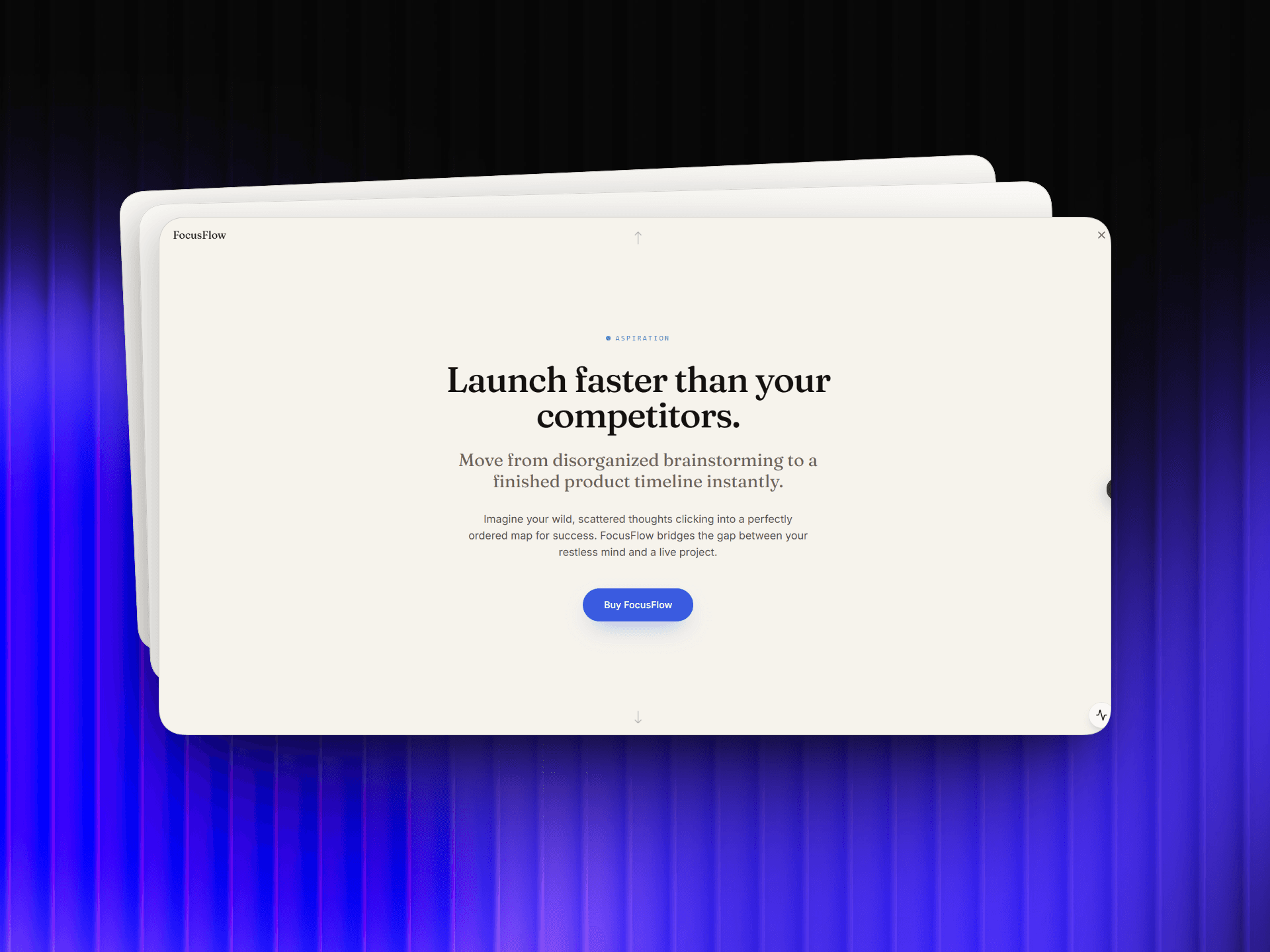
An experimental landing page that uses an LLM to adapt its content based on a visitor's scrolling and reading patterns.Creator · Prototype · July 11, 2026
I wanted to explore how an LLM would adapt a product pitch using a visitor's
behavior on the page. The prototype gives the model a record of scrolling,
reading time, and revisits, then uses that information to generate the next
section.
Overview
Adaptive Conversion Feed presents a fictional product, FocusFlow, through a
vertical feed of full-screen landing-page sections. An LLM generates each
section using a different messaging approach, such as social proof, curiosity,
or cost savings, informed by the visitor's interactions with previous sections.Visitors are told up front that the page adapts to their behavior. They can
scroll, revisit sections, leave, or click the call to action.
How it works
Behavioral tracking. A session engine records time spent on each card,
scroll depth, revisits, and scroll direction. Reading time is compared with
the expected time for each card's word count, allowing comparisons between
cards of different lengths.
Content generation. Each new card uses the session's interaction history.
The prompt varies the messaging approach and tone while discouraging repeated
wording.
Self-reflection loop. After each card, the model summarizes its
interpretation of the interaction and uses that summary to guide the next
card. At the end, it produces a session summary linking engagement and any
call-to-action click to the content shown.
Research dashboard. A live panel shows per-card metrics, the model's
intended approach, its subsequent reflections, and exportable session JSON.
Observations
In my own sessions, clear, general descriptions of the product often seemed
more effective than highly personalized copy. These were informal observations,
not results from a controlled study.The model sometimes inferred too much from a few interactions. For example,
revisiting a pricing card could lead it to assume the visitor was particularly
cost-conscious. Copy based on those assumptions often felt unnatural.The main limitation is the ambiguity of the signals. Time spent on a card
cannot distinguish careful reading from someone leaving the tab open. The
model's explanation can sound confident even when the evidence is weak.The project was informed by Hackenburg & Margetts (PNAS, 2024),
commentary by Teeny & Matz (PNAS, 2024),
and a survey of empirical LLM-persuasion studies.
My sessions were not a replication of these studies.
Design constraints
The product is fictional, and visitors are told how the page adapts. The
prompts prohibit fabricated statistics, fake scarcity, and appeals that exploit
fear or insecurity. The dashboard makes the model's interpretations visible
so they can be compared with the interactions that prompted them.